Sambal Belacan I
3 - Dinner, Spread, Relish & Pickle
Ingredients
- 5 finger length chilli deseeded
- 3 chilli padi aka bird’s eye chilli (no need to deseed – for the heat omit or adjust to your preference)
- 30g belachan toasted in a dry pan
- 1 tsp sugar
- 3/4 tbsp lime juice from small limes (calamansi)
- 1/8 tsp salt
Description
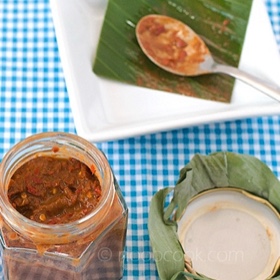
A bottle of homemade sambal belacan (belachan) – a handy condiment to have.
Making your sambal belachan is really easy since there’s no cooking involved (except the toasting belachan part), and once you made some, it stores in the fridge for slightly more than a week. Mine is the more Malay style (I think) where there’s no frying of the paste involved. But with this basic sambal paste, you can fry it with some dried shrimps, garlic and shallots for a more Chinese version of spicy dried shrimps, or more commonly known locally as hae bee hiam (upcoming recipe). A little warning though – your kitchen will smell kind of pungent when you make sambal or when you cook with sambal – but to me, a small price to pay for something so delicious.
Directions
In a blender, grind chillis and belachan. You can also pound the ingredients using a mortar & pestle.
Transfer blended paste to a small bowl. Add sugar, lime juice and salt to taste. Stir to mix well. You can store the chilli in refrigerator for one week or so. It can be used as a chilli condiment or in stir fries.
Notes
Shrimp paste or shrimp sauce, is a common ingredient used in Southeast Asian and Southern Chinese cuisine. It is known as terasi (also spelled trassi, terasie) in Indonesian, ngapi (ငါးပိ [ŋəpḭ]) in Burmese, kapi (กะปิ) in Thai, Khmer (កាពិ) and Lao language, belacan (also spelled belachan, blachang) in Malay, mắm ruốc, mắm tép and mắm tôm in Vietnamese (the name depends on the shrimp used),[1] bagoong alamang (also known as bagoong aramang) in Filipino, haam ha/ha jeung in Cantonese Chinese and hom ha/hae ko (Pe̍h-ōe-jī: hê-ko) in Min Nan Chinese.
It is made from fermented ground shrimp mixed with salt. Some versions are in its wet form such as those in Vietnam and other versions are sun dried and either cut into fist-sized rectangular blocks or sold in bulk. It is an essential ingredient in many curries and sauces. Shrimp paste can be found in most meals in Myanmar, Laos, Thailand, Malaysia, Singapore, Indonesia, Vietnam and the Philippines. It is often an ingredient in dip for fish or vegetables.
Tips
1. Wear disposable plastic gloves when de-seeding chilli to prevent chilli burn.
2. Belachan is pungent smelling. Open your windows while toasting belachan and remove all laundry (if you have them in the kitchen) before making the sambal. Air your kitchen after cooking.
3. If you do not have calamansi, you can substitute with larger lime or lemon (though I think calamansi gives it the best taste).